
Dauphin Projected Versus Actual Release
Projected, minimum, maximum, parole-eligibility, and actual release dates answer different questions. Pennsylvania sentences generally state a judicial minimum and maximum. For an eligible state sentence, the minimum is ordinarily the first point when parole may become possible. It is not a release appointment. The maximum is the sentence endpoint, subject to lawful recalculation and later events. Actual release is the custody event recorded by the facility after all current authority and holds are checked.
A pretrial detainee has not yet received a custodial sentence for the pending charge. That person may leave after bail is posted or an order changes, remain held because bail is not met, or stay under another detainer. No responsible source can calculate a fixed day from the charge alone. For a county-sentenced person, Dauphin County and the court own the key computation records. For a state-sentenced person, PA DOC computes dates from the commitment and later court or Board events.
The Dauphin inmate lookup shows a Release Date for a county episode, not an advertised projected-date field. It can also mark transfer from county custody to PA DOC, another county, or another authority. Read the destination and docket before calling it freedom.
Find a Dauphin Release Date
Begin by identifying the current custodian. The official Dauphin County search is useful for county bookings because it offers an “Include released inmates” checkbox and a Release Date result column. The PA DOC locator serves current state inmates and, through a separate tab, current department-supervised people. Its current inmate detail does not expose a universal minimum, maximum, projected, sentence, or historical discharge field. That limit makes record ownership vital.
- Search the Dauphin County inmate lookup by name and date of birth, or use a known booking or institutional number. Select “Include released inmates.”
- Open the matching county result and preserve the booking number and Release Date. Treat a blank date as unresolved, not proof of custody.
- Review the UJS criminal docket for bail, sentence, credit, concurrent or consecutive terms, and later orders.
- If the docket shows transfer to state custody, search PA DOC by inmate number or name, age, and Dauphin as committing county.
- Ask Dauphin County for a sentence-computation sheet or release record when a county sentence cannot be resolved online. Ask PA DOC central records for state computation or discharge material.
- Confirm an actual event through the responsible facility or notification service. Do not calculate a day by simple subtraction.
The PA DOC landing page shows the inmate and supervised-person routes used for a Dauphin state case.
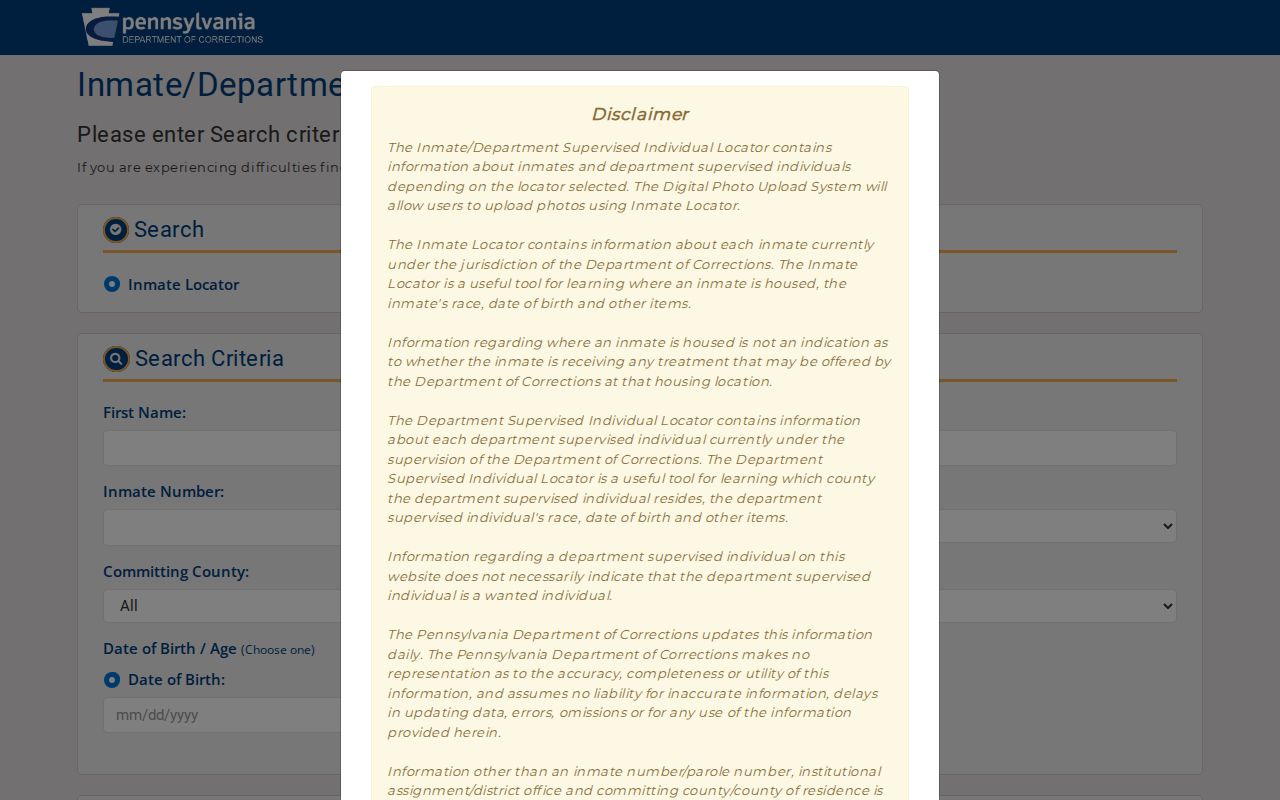
The image also reinforces the split between current confinement and release into state supervision. A supervised-person detail may show a Release Date, but that means release to supervision, not final discharge from the sentence.
The current inmate detail offers identity and location fields rather than a public sentence calendar. Verified fields include names and aliases, inmate and parole numbers, date of birth, current and permanent location, committing county, age, citizenship, a facility link, last-update information, and a DOC photograph with its photo date. It did not expose a minimum date, maximum date, projected date, offense, sentence, release reason, or historical discharge status during the research review. The supervised-person detail is different: it can show a parole number, Release Date, state, image, last update, and an explicit wanted marker when coded as a parole absconder. Those differences explain why a family member cannot safely infer a Dauphin projected release date from an identity record. Search the correct tab, retain the DOC or parole number, and ask for the agency’s existing computation record when the needed date is not public.
For the full county release-record route, the Dauphin County released-inmate lookup explains how the facility date and court order fit together.
Pennsylvania Sentence Dates in Dauphin
Under 42 Pa.C.S. § 9756, a court imposing total confinement generally states a minimum that does not exceed one-half the maximum, subject to exceptions. The minimum governs eligibility rather than a guaranteed exit. 61 Pa.C.S. § 6137 authorizes parole for eligible people after the lawful minimum, with statutory exclusions, voting rules, and release conditions.
The Pennsylvania Parole Board can grant, refuse, defer, or later rescind a decision before release. Even a grant can remain subject to an approved plan or another hold. A detainer is a request or legal basis for another authority to keep or receive custody. Thus the Board decision, PA DOC computation, and actual facility event may carry different dates without contradicting one another.
County parole differs. A Dauphin County judge decides parole from a county sentence, and county Adult Probation handles that local path. The PA DOC state locator should not be used to infer a county parole date. The court order and county sentence-computation record control.
Note: Pennsylvania has no universal rule requiring every state or county prisoner to serve exactly 85 percent before release.
Dauphin Release Credit Rules
Credit for time already spent in custody is governed by 42 Pa.C.S. § 9760. The agency calculation must apply the sentencing order to the actual custody history. Credit may be affected by pre-sentence confinement and by how concurrent or consecutive terms are combined. Amended orders, escape time, parole violations, and recommitment may also change the result. These facts cannot be reconstructed safely from the public county Release Date alone.
Pennsylvania’s Recidivism Risk Reduction Incentive, or RRRI, is a specific state program, not routine good time for everyone. Under 61 Pa.C.S. Chapter 45, an eligible person may receive an RRRI minimum. When the regular minimum is three years or less, the statutory RRRI minimum is three-fourths of that minimum. When it exceeds three years, the figure is five-sixths. Those are 75 percent or about 83.33 percent of the minimum, not 85 percent of the maximum.
Eligibility has many exclusions. Release also requires DOC findings tied to assessment, the program plan, conduct, reentry planning, and continuing eligibility. An RRRI minimum should be labeled exactly as such. It remains a special eligibility date, not a promise that the person will leave on that day.
Short Sentence Parole under 61 Pa.C.S. § 6137.1 is another limited state path for certain commitments with aggregate minimums of two years or less. It has exclusions and possible bars. It cannot be treated as a general Dauphin County jail formula or derived from an online lookup.
Why Dauphin Release Dates Change
A computed date is a snapshot of the current legal record. Changes do not all move it in the same direction, and some affect eligibility rather than the maximum. The following factors need confirmation from the agency that owns each record.
| Factor | Possible effect | Source to check |
|---|---|---|
| Custody credit | Changes time credited toward the sentence | Court order and computation sheet |
| Concurrent or consecutive terms | Changes how multiple sentences combine | Sentencing dockets |
| Amended court order | Corrects or alters the controlling judgment | Certified docket/order |
| Detainer or warrant | Can block community release or cause transfer | Facility and responsible authority |
| Parole decision | May authorize release after eligibility, subject to prerequisites | Parole Board and PA DOC |
| Violation or recommitment | Can recalculate parole and maximum dates | Board/DOC record |
| RRRI eligibility | May create a separate minimum for a qualifying state case | Sentence and PA DOC certification |
A county Release Date can also represent movement into more custody. If a person leaves Dauphin County Prison for PA DOC, the county episode has ended but incarceration has not. The state inmate locator should then show continuing state jurisdiction after its records update. Federal and immigration transfers require their own systems.
Note: A no-result screen is evidence only that a search was run; it does not establish release, transfer, or discharge.
Dauphin County Date Records
For a Dauphin county sentence, ask for an existing record instead of asking staff to predict a day. A narrow request may seek the sentence-computation sheet, commitment and discharge dates, Prison Release Notification, release destination or status code, and the booking number tied to the episode. The county’s Open Records page provides the Right-to-Know route. Pennsylvania agencies ordinarily respond within five business days, although a lawful extension can add time.
For state custody, PA DOC central records and its Right-to-Know request page are the proper channels. A request can identify the person by DOC number and seek an existing sentence-status summary, parole or max-out date, or discharge date if releasable. It should not ask DOC to create a projection that is absent from its records.
The court has a separate role. A certified sentencing order is obtained from the Dauphin County Clerk of Courts, while the facility owns the physical custody record. Neither source should be asked to certify the other agency’s event.
Confirm Dauphin Actual Release
Actual release is checked after the projected-date work is done. PA SAVIN uses VINE to deliver participating county-jail, state-prison, and state-parole alerts for release, transfer, and escape. A transfer alert must not be called a release to the community. Notifications are timely aids, not certified discharge records.
The VINELink Inmate Search can help track the right Dauphin or PA DOC record and register an alert. Match the name, identifying data, and facility carefully. Then confirm the event with Dauphin County Prison, PA DOC, or the relevant record owner if the exact status matters.
For state parole, compare three items: the eligibility or Board decision, the Department Supervised Individual record, and the actual release event. They can be dated differently. After final discharge, the person may no longer appear in either current PA DOC locator tab, so an official record request becomes the durable route.